Which countries owns the most US government debt?
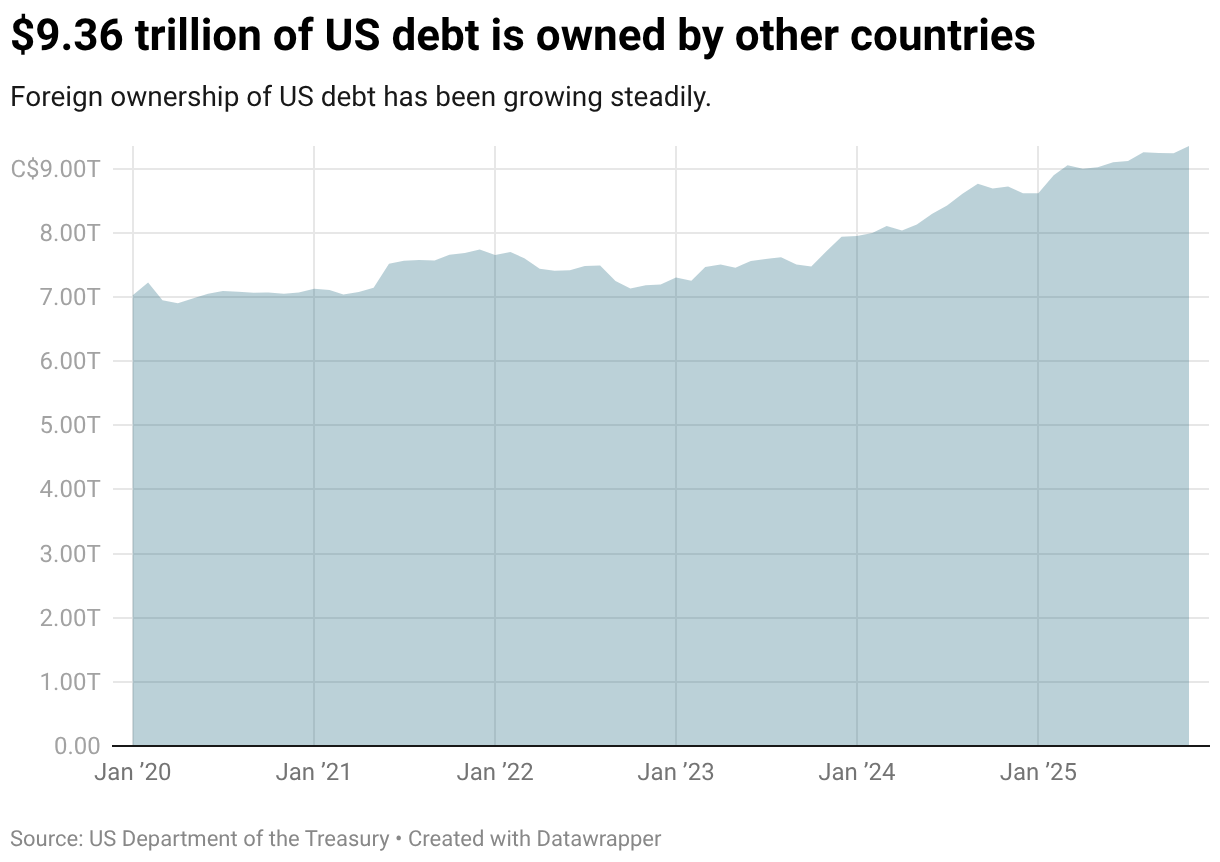
As of November 2025, total US government debt reached $36.2 trillion. This figure represents the total amount of money the United States government has borrowed. When the federal government spends more than it collects from taxes and other revenues, it must borrow to cover its expenses. It does this by selling US Treasury Securities, which are short- or long-term investment instruments, and using the proceeds to pay the outstanding balance. Individuals, businesses, and governments, including those from outside of the United States, can purchase US Treasury Securities. These investments are fully backed by the United States government, making them a popular product among investors worldwide. As of November 2025, the value of US Treasury Securities held by foreign investors amounted to $9.35 trillion, representing 25.8% of total US government debt.
Why do foreign countries buy US debt?
Foreign governments and investors buy U.S. Treasury securities because they are widely seen as one of the safest and most reliable assets in the world. U.S. debt is backed by the federal government, issued in a stable currency, and supported by deep, liquid financial markets. This makes Treasuries an attractive place to store large amounts of money, especially during periods of global uncertainty.
Many countries also purchase U.S. debt as part of their foreign exchange reserves. Holding Treasuries helps central banks manage their currencies, stabilize financial systems, and ensure they have readily available funds in times of crisis. In addition, countries that run trade surpluses with the United States often reinvest their U.S. dollar earnings into Treasury securities, creating a steady cycle of exports, dollar accumulation, and debt purchases.
Japan is the top holder of US debt
As of November 2025, ten US debt holders own 61.2% of all foreign-owned debt. Japan was the largest holder of US treasuries with a position valued at $1.20 trillion. They held over $200 million more in US debt than the United Kingdom, the next largest debt holder, which had $888 billion. The UK is followed by China, which held $682 billion in US debt. The top three, Japan, United Kingdom and China own about 30% of all foreign-owned debt. Both Japan and the United Kingdom held more US debt compared to the same period the year before, while China’s position declined.
Where does Canada rank? Canada is a significant holder of US debt. As of November 2025, it was the fifth-leading owner of US Treasury Securities with a holding valued at $472 billion.

Short-term versus long-term debt
US Treasury securities fall into two main categories — short-term and long-term. Short-term treasuries include Treasury Bills or T-bills and Treasury Notes or T-notes. They have short durations to maturity, ranging from 4 to 52 weeks for T-bills and between 2 and 10 years for T-notes. Meanwhile, Treasury bonds are classified as long-term investments that have 20 and 30 year maturity.
Why does the US government track foreign ownership of treasuries?
All data on foreign-owned U.S. debt comes from the U.S. Department of the Treasury’s Treasury International Capital (TIC) system, which publishes monthly summaries of current foreign-owned U.S. debt. The specific dataset used in this article is called “Monthly Holdings of Securities (foreign holdings of U.S. securities, and U.S. holdings of foreign securities”. Tracking who owns U.S. government debt helps explain how money moves around the world and how much trust investors place in the U.S. dollar. When foreign governments and investors buy U.S. Treasuries, it shows how global economic conditions influence where people choose to put their money. Because these holdings change over time, the data helps reveal shifts in global confidence and shows how overseas demand can affect the stability of the U.S. government’s borrowing market.
What are the risks of foreign countries owning US debt?
Foreign ownership of U.S. government debt carries risks that matter for long-term economic stability. When foreign governments and investors hold large amounts of U.S. Treasuries, sudden shifts in their buying or selling can affect interest rates and financial markets. If confidence weakens or global conditions change, reduced demand for U.S. debt could push borrowing costs higher and make it harder for the government to finance its deficits.
This reliance on foreign capital is also tied to ongoing trade deficits, where the U.S. imports more than it exports to sustain investment inflows. While this supports short-term spending, it adds to national debt and can create imbalances across the economy. Over time, these pressures can affect domestic industries, jobs, and the overall resilience of the U.S. economy.
