What is the Human Development Index, and what does it reveal?
The Human Development Index (HDI), developed by the United Nations, provides a snapshot of a country’s performance across three key dimensions: health, education, and standard of living. The health dimension is measured by life expectancy at birth for both sexes. Education is assessed using two indicators: the average years of schooling for adults aged 25 and older, and the expected years of schooling for children entering school. The standard of living dimension is measured by gross national income per capita, which is the total income earned by a country’s residents and businesses, including income from abroad, divided by the population.
Each dimension is assigned a score, which is then combined into a single composite index — one overall measure that summarizes performance across all dimensions. This is calculated using a geometric mean, which multiplies the three scores and then takes the cube root, since there are three dimensions. This method helps reduce the impact of very high or very low values in any one category.
The HDI score ranges from 0 to 1, with higher values indicating higher levels of development. Scores are grouped into four categories:
Very high human development (0.8-1.0)
High human development (0.7-0.79)
Medium human development (0.55-0.69)
Low human development (>0.55)
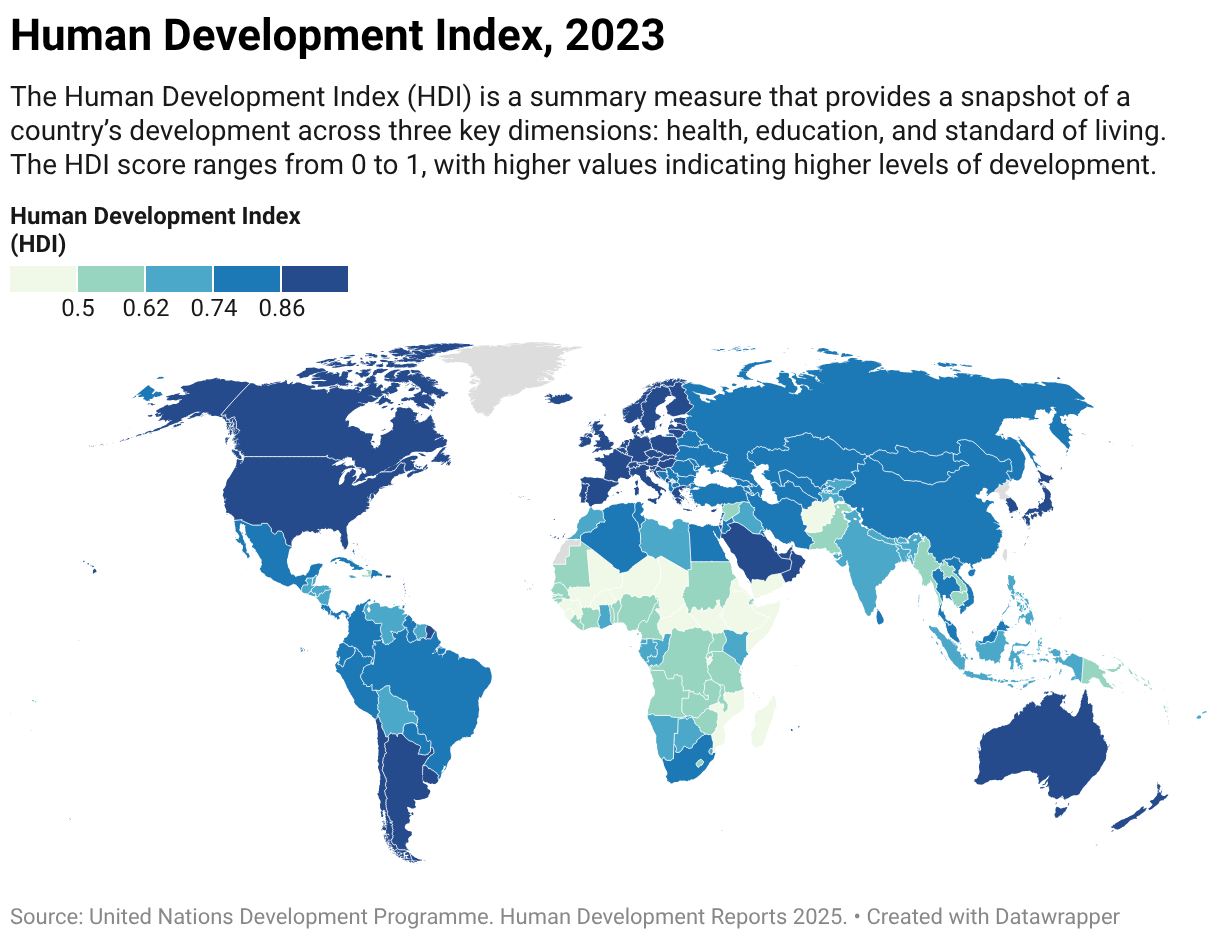
Which country has the highest HDI?
The latest data from the United Nations Development Programme (UNDP) reveals that a group of Nordic countries, Iceland, Norway, and Sweden, are among the nations with the highest human development, with Iceland taking the top spot. Nine of the ten countries with the highest HDI are in Europe, with Australia being the lone country from outside this region. At the other end of the spectrum, the ten countries with the lowest HDI are all from Africa. The full list of countries ranked by HDI and key statistics used to calculate HDI can be found below.
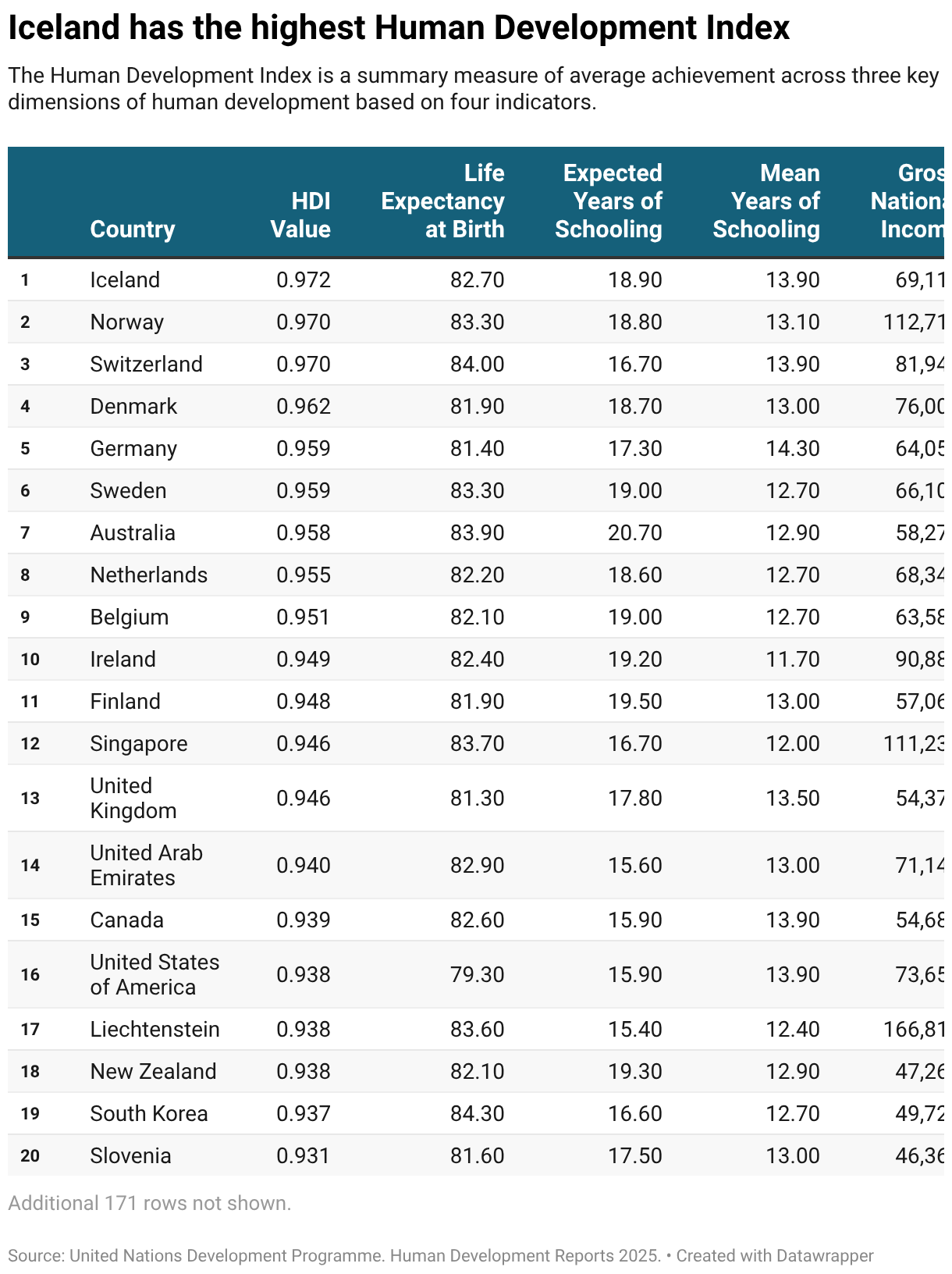
What are the limitations of the HDI?
While the Human Development Index is useful in comparing development across countries, it has significant limitations. By focusing on just three key dimensions, the HDI oversimplifies the complexity of human development. The HDI does not account for factors such as political freedom, environmental sustainability, legal rights, or social institutions, which are crucial for humans to flourish. By using national averages for each dimension, the HDI may also mask disparities that exist at regional levels and how key factors affect specific groups within a country.
Another limitation is in how the HDI scores are calculated. Each dimension is given equal weighting, which neglects the relative importance of each dimension based on a country’s priorities. For example, advanced economies may focus more on education, while countries emerging from conflicts may focus more on rebuilding their health systems.
The Human Development Index is a great place to start, but it should be used with other metrics to provide a more holistic picture of human development within and across countries.
