How is the United Nations funded?
In 2025, the United Nations (UN) celebrated a major milestone — its 80th anniversary. Founded in 1945, after the end of World War II, the organization’s goal is to promote international cooperation and maintain peace and security among nations. As the world’s largest intergovernmental organization, the UN serves as a forum for its 193 members and 2 observer states to discuss and resolve conflicts and organize relief for humanitarian crises.
What is the UN’s annual budget?
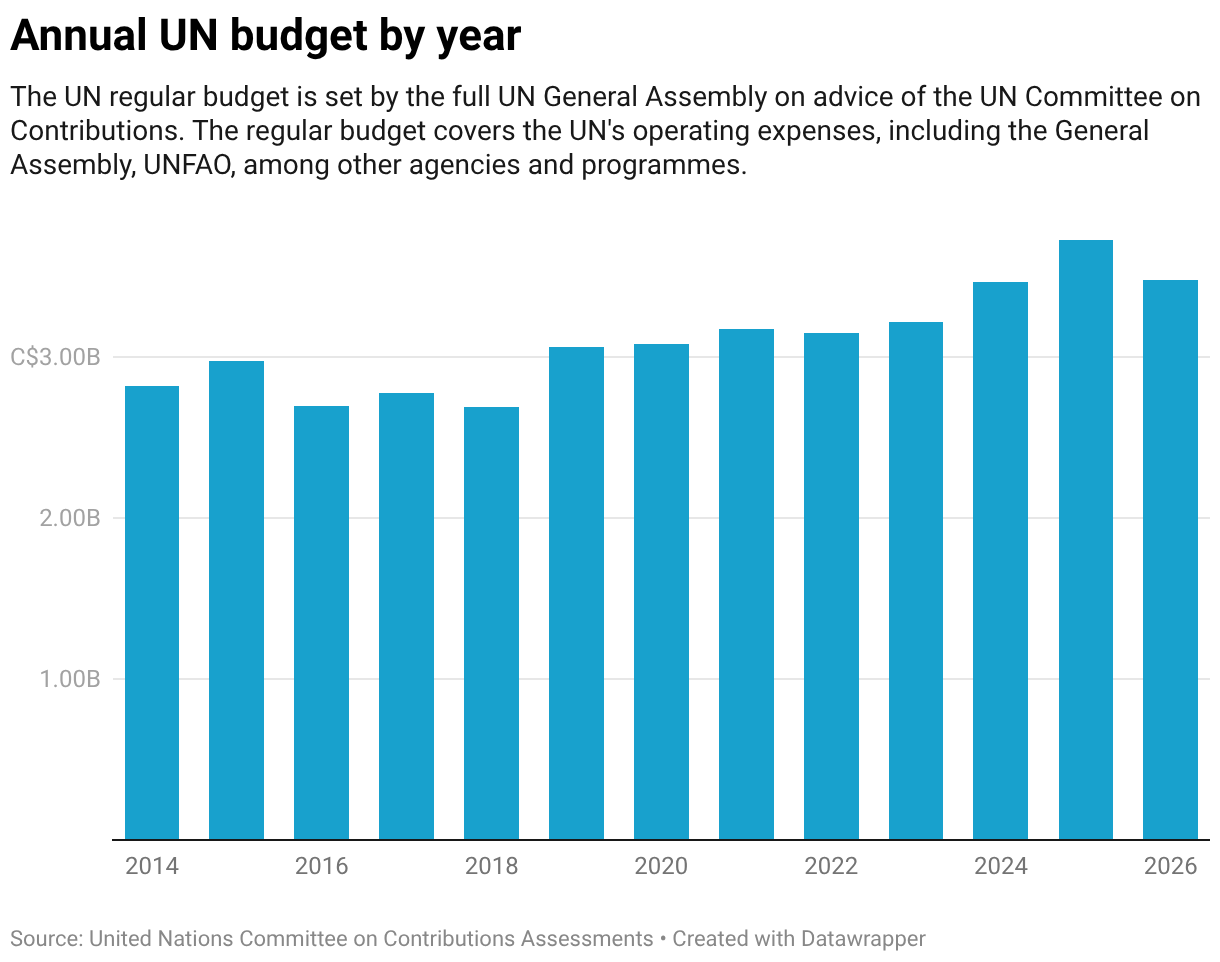
The UN budget is set by the UN General Assembly and is separated into two parts: the regular budget, which finances core organizational activities; and the peacekeeping budget, which funds most UN peacekeeping missions. Funding for the United Nations budget comes from its 193 members through mandatory assessed contributions. On December 30, 2025, the UN General Assembly approved a regular budget of USD $3.45 billion for 2026. It represents a slight decline from the year before. Since 2014, the UN’s budget has fluctuated annually from a low of USD $2,688,127,790 in 2016 to a high of USD $3,729,027,200 in 2025.
How much does each member contribute?
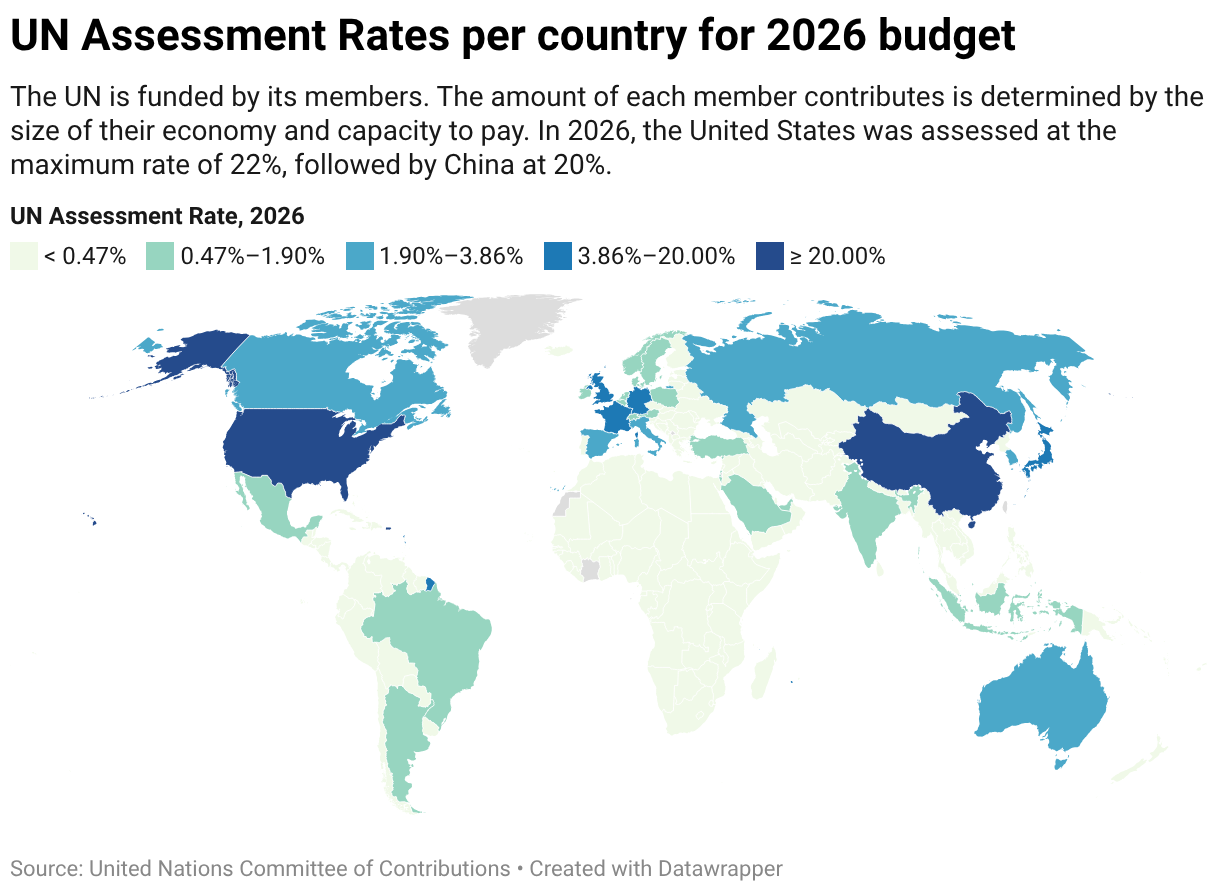
The amount each member is required to contribute is calculated using a formula that considers their gross national income (GNI), debt burden, and population, among other factors. The UN Committee on Contributions, a committee of 18 members selected by the General Assembly, advises the General Assembly on how much each member should contribute based on their capacity to pay. The minimum assessment rate applied to members is 0.001 per cent of the budget, and the maximum assessment rate is 22 per cent. Assessment rates are capped at 0.01 per cent for the least developed countries.
Rule 159 of the Rules and Procedures of the General Assembly outlines who can serve on the committee. It states that no two members of the committee can be nationals from the same state, and members are selected on the basis of broad geographical qualifications and experience. Members serve three-year terms. The following are current members of the committee.
The United States is the top contributor
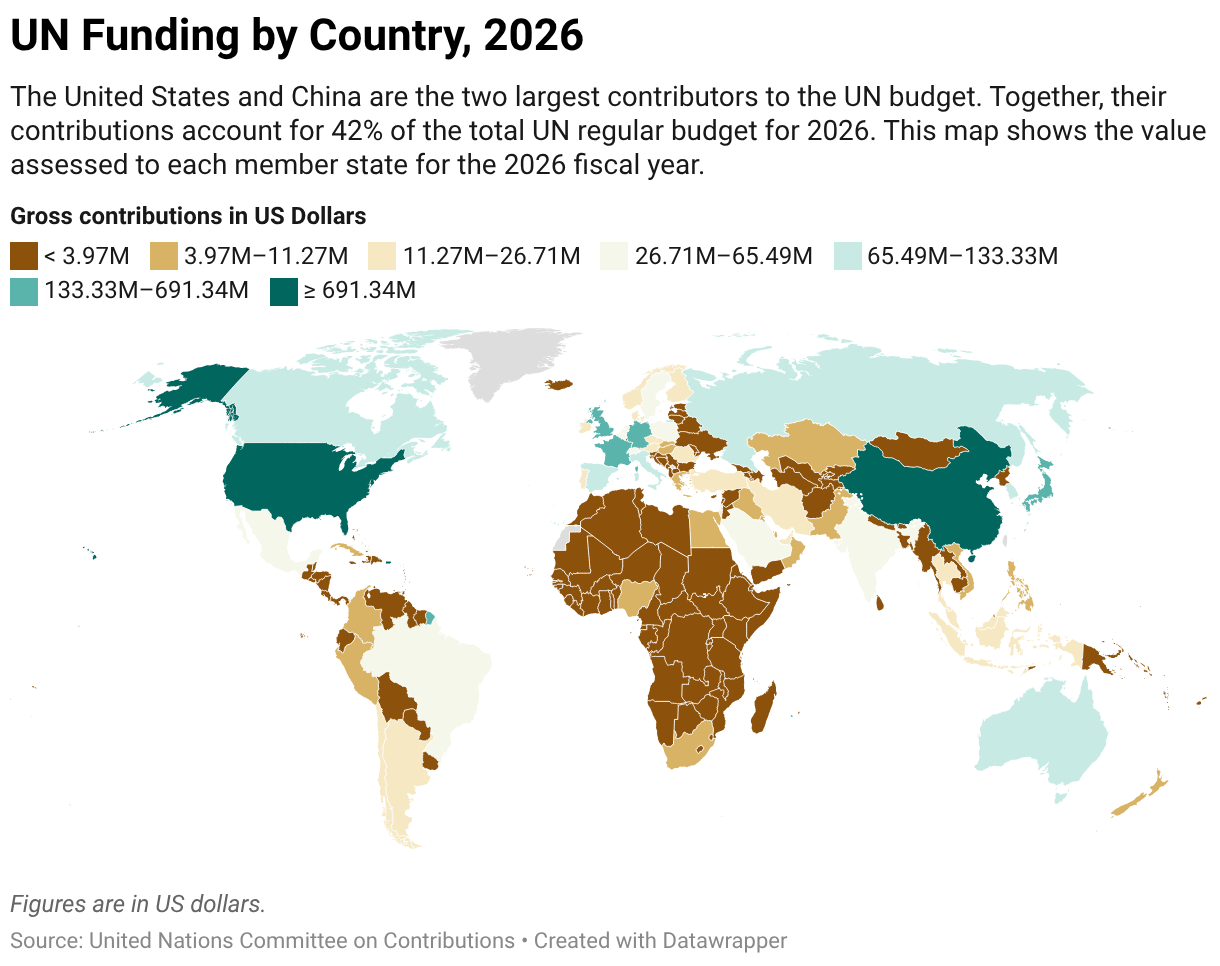
The United States has historically been the largest contributor. In 2025, the United States was responsible for approximately 22% of the UN regular budget, and about 26% of the peacekeeping budget. China, was the second largest contributor, accounting for about 20% of the UN’s regular budget. In dollar terms, the United States contributed $820 million of the UN’s $3.54 billion budget, while China contributed $620 million.
In 2026, the United States was assessed at the top rate at 22% of the total UN regular budget, while China was assessed at 20% of the UN budget. Together, their contributions represent 42% of the funding for the UN’s regular budget. Eighteen members are assessed rates above one percent. Together, they make up 83 percent of the total budget. Meanwhile, 28 members that are assessed at the minimum rate of 0.001 percent.
Members don’t always pay their dues
The timely payment of assessments is crucial for the organization’s financial stability. Historically, the greatest number of members pay their regular budget assessments in full within the first few months of the year. However, some members fail to make their full payments by the end of the fiscal year. In 2025, only 151 of the 193 members paid their regular budget assessments in full.

Between 2001 and 2025, there hasn’t been a single year in which all members have paid their assessments in full. During this time, an average of 141 members pay their assessments in full. The most members in a year were 153, recorded in 2021, while 2002 saw the fewest, 117, make their full contributions. There are real consequences for failing to meet their financial obligations. Under Article 19 of the Charter of the United Nations, a member state in arrears can lose its vote in the General Assembly.
